
Resources
What is a bleeding disorder?
What the disorders are, who gets missed, and what is coming next.
Bleeding disorders are a group of disorders that share the inability to form a proper blood clot. Symptoms include extended bleeding after injury, surgery, trauma, or menstruation. Sometimes the bleeding is spontaneous, without a known or identifiable cause. Improper clotting can be caused by defects in blood components such as platelets and/or clotting proteins, also called clotting factors. The body produces 13 clotting factors. If any of them are defective or deficient, blood clotting is affected; a mild, moderate or severe bleeding disorder can result.
Some bleeding disorders, such as hemophilia, can be inherited or acquired. Others can occur from such conditions as anemia, cirrhosis of the liver, HIV, leukemia, and vitamin K deficiency. They also can result from certain medications that thin the blood, including aspirin, heparin, and warfarin.
Jump to
The disorders
The three you will hear named most
Treatment can mean life-long infusions of clotting factor, and costs between $60,000 and $260,000 a year.
Hemophilia A
Factor VIII (8) deficiency, or classic hemophilia
Hemophilia A, also called factor VIII (8) deficiency or classic hemophilia, is a genetic disorder caused by missing or defective factor VIII (FVIII), a clotting protein. Although it is passed down from parents to children, about 1/3 of cases found have no previous family history.
According to the US Centers for Disease Control and Prevention (CDC), hemophilia occurs in approximately 1 in 5,617 live male births. There are between 30,000 – 33,000 males with hemophilia in the US. More than half of people diagnosed with hemophilia A have the severe form. Hemophilia A is four times as common as hemophilia B. Hemophilia affects all races and ethnic groups.
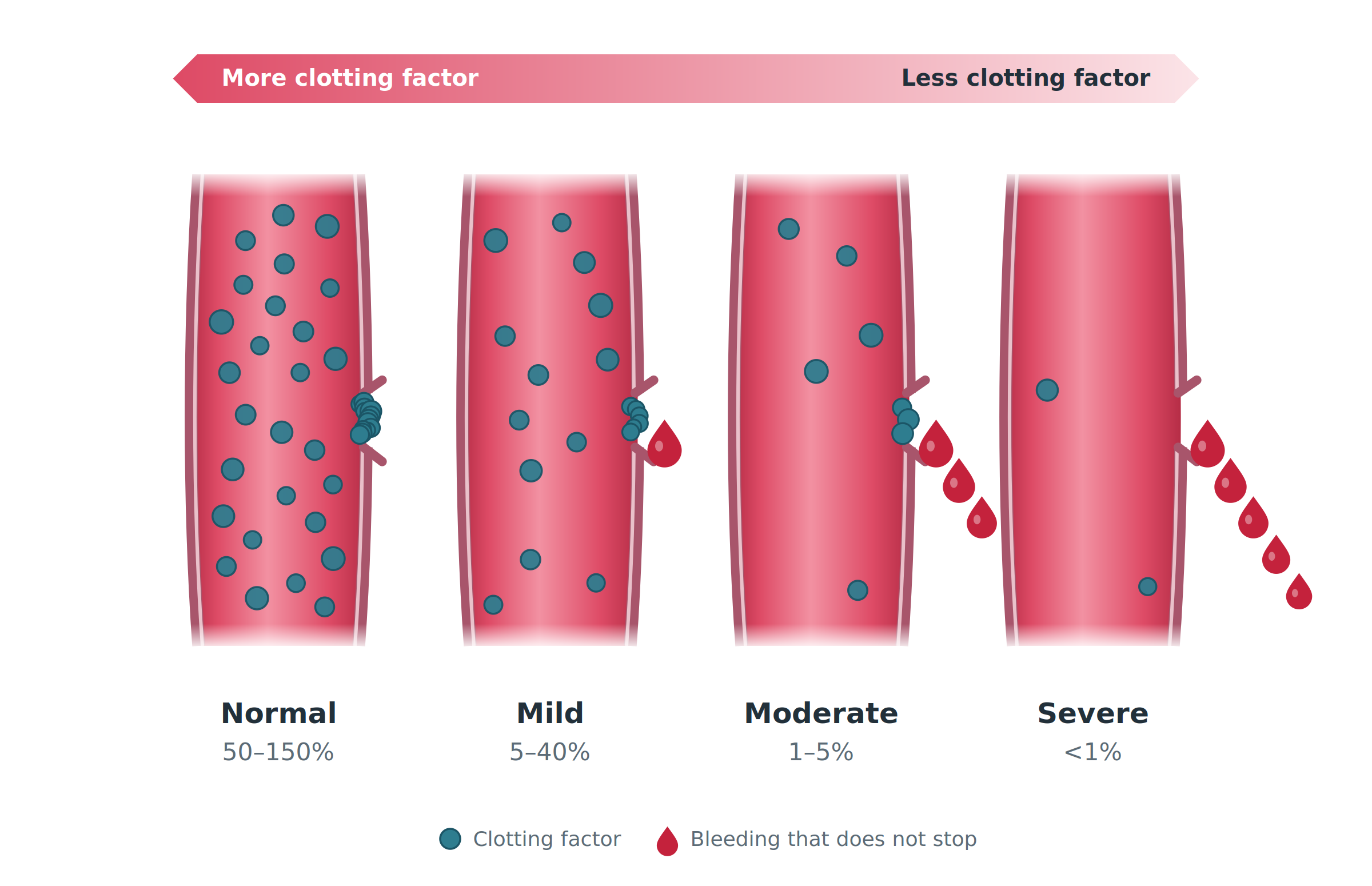
Severity · share of all hemophilia A
Hemophilia B
Factor IX (9) deficiency, or Christmas disease
Hemophilia B, also called factor IX (FIX) deficiency or Christmas disease, is a genetic disorder caused by missing or defective factor IX, a clotting protein. Although it is passed down from parents to children, about 1/3 of cases are caused by a spontaneous mutation, a change in a gene.
According to the US Centers for Disease Control and Prevention, hemophilia occurs in approximately 1 in 5,000 live births. There are between 30,000 – 33,000 people with hemophilia in the US. All races and ethnic groups are affected. Hemophilia B is four times less common than hemophilia A.
Von Willebrand Disease
VWD — the most common bleeding disorder
Von Willebrand disease (VWD) is an inheritable bleeding disorder. Many different proteins are needed to make a person's blood clot successfully. People with VWD are either missing or low in the clotting protein von Willebrand factor (VWF) — or it doesn't work as it's supposed to. For a person to make a successful clot, VWF binds to factor VIII (8), another clotting protein, and platelets in blood vessel walls. This process will help form a platelet plug during the clotting process. People with VWD are not able to form this platelet plug, or it will take longer to form. The condition is named after Finnish physician Erik von Willebrand, who first described it in the 1920s.
VWD is the most common bleeding disorder, affecting up to 1% of the US population — or approximately 1 in every 100 people. It occurs equally in men and women. However, women may be more symptomatic due to heavy menstrual bleeding (periods). VWD occurs equally across all races and ethnicities.
The descriptions of each disorder are the National Bleeding Disorders Foundation's. Everything on this page is education, not medical advice — your treatment center is who to ask about your own care.
Rarer still
The other factor deficiencies
In the US, a rare disease or disorder is defined as one that affects fewer than 200,000 people. This means hemophilia A and B, and the less-common factor deficiencies such as I, II, V, VII, X, XI, XII and XIII, are all rare disorders.
Blood clotting is a complex process, involving many different proteins, called factors, each of which plays a different role in the blood clotting process. Factor deficiencies are defined by which specific clotting protein in the blood is low, missing or doesn't work properly.
Bleeding basics
How a bleed actually works
Thirteen clotting factors have to fire in order. When one of them is missing or faulty, the sequence stalls. That is the whole of it, and this is where to see it explained properly.
NBDF's video explaining how the thirteen clotting factors work in sequence. The hardest idea on this page, and the one worth watching rather than reading.
Women and bleeding disorders
It is not only men, and the myth has a cost
It is a common misconception that only men are affected by bleeding disorders. In reality, these conditions can impact anyone, regardless of sex. Von Willebrand Disease (VWD) — the most common inherited bleeding disorder — affects approximately 1% of the population, meaning over 3 million Americans may be living with the condition.
Women who carry hemophilia genes and have low clotting factor levels can also experience abnormal bleeding. These individuals are often referred to as symptomatic carriers and, in some cases, may be considered to have mild hemophilia. In addition to hemophilia and VWD, women and girls can also be affected by rare factor deficiencies (such as factors I, II, V, VII, X, XI, and XIII) as well as platelet function disorders.
Due to the long-standing myth that women do not have bleeding disorders, many go undiagnosed or are misdiagnosed — often with serious consequences. This lack of recognition can lead to untreated, heavy menstrual bleeding that significantly affects quality of life. In some cases, it has resulted in unnecessary medical procedures, such as hysterectomies, or dangerous complications during childbirth, surgery, or after injuries.
Given how common VWD is, the American College of Obstetricians and Gynecologists recommends screening for VWD in any adolescent experiencing severe menstrual bleeding (menorrhagia). They also advise screening for adult women with unexplained heavy periods and before any hysterectomy that is being considered due to excessive menstrual bleeding.
Dismissed
A documentary about women with hemophilia, released at the National Bleeding Disorders Foundation's Bleeding Disorders Conference in August 2025. It is about the struggle women have had, and still have, to be diagnosed and treated at all.
What is coming next
Research, trials and gene therapy
None of this is settled, and none of it is treatment advice. It is where the field is looking, and how to follow it yourself.
Clinical trials
Clinical trials are research studies that evaluate the safety and effectiveness of new treatments, therapies, or medical approaches for conditions like bleeding disorders. They follow a structured process with different phases, starting with small groups to assess safety and gradually involving more participants to measure effectiveness and monitor side effects. These trials are essential for advancing medical care by ensuring that new treatments are both safe and beneficial before becoming widely available.
Gene therapy
Gene therapy is an innovative approach aimed at treating or potentially curing bleeding disorders by addressing the underlying genetic causes. This therapy involves delivering a functional copy of a gene into the body to replace or repair the faulty gene responsible for a bleeding disorder. The goal is to enable the body to produce the necessary clotting factors on its own, reducing or eliminating the need for regular treatments.
The National Research Blueprint
The National Research Blueprint is an initiative of the National Bleeding Disorders Foundation that aims to advance the understanding, treatment, and care for those living with bleeding disorders. This comprehensive strategy focuses on identifying research priorities, promoting collaboration across medical and scientific communities, and advocating for the resources necessary to address critical gaps in knowledge and care.
Where to next
Newly diagnosed?
The medical descriptions on this page are the National Bleeding Disorders Foundation's.